
Study notes
How to Make a Study Guide From Lecture Recordings and Slides
Combine lecture explanations and slides into a study guide with worked examples, practice questions, answers, and references you can check.
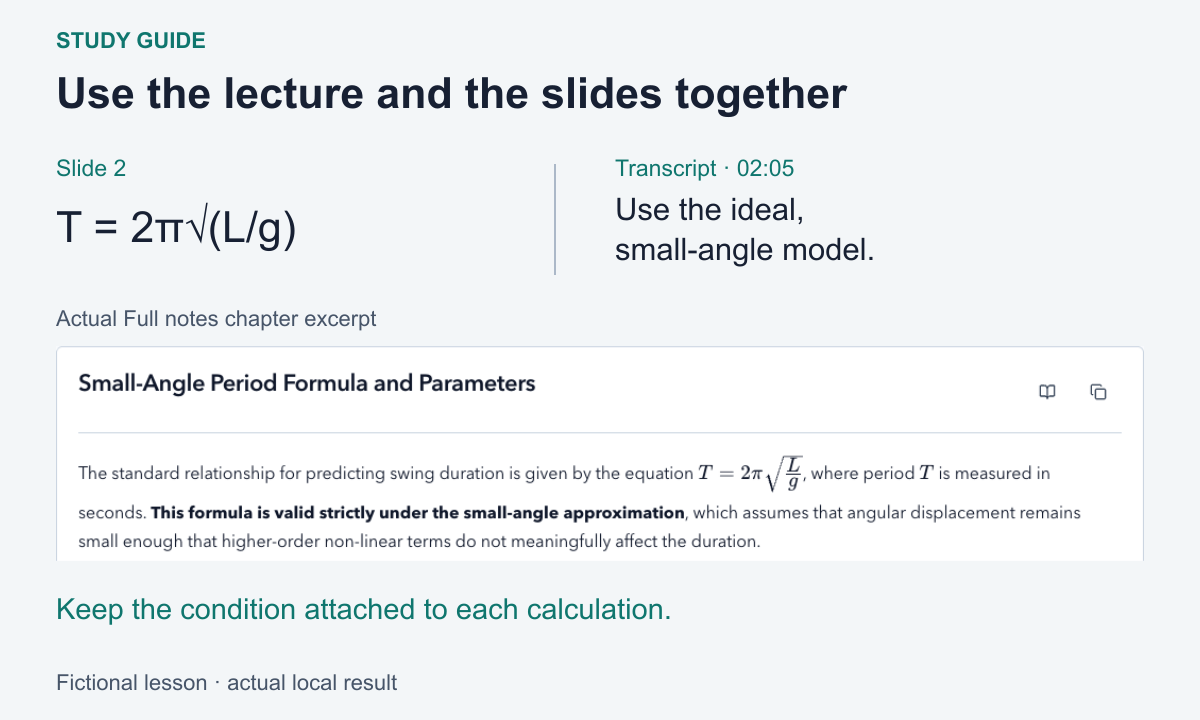
Build your guide around what you need to explain or calculate. Put the lecture's spoken qualifications beside the relevant slide, work through an example, and write questions whose answers you can check in the original material.
Below is a finished guide you can use as a model, followed by the steps behind it. The transcript, slides, and completed guide are available without an account.
Start with a guide you can study from
The pendulum lesson is fictional. Vyxora Editorial wrote its transcript and slides for this exercise. The guide below is an editorial worked example. It is not a real class or a measured learning result. The Vyxora walkthrough later uses the transcript as its input; it does not test recording or audio transcription.
Select Copy text and paste the example into a study document. For your own lesson, replace the topic, explanations, calculations, questions, and source locations with material from your course. Keep conditions and unresolved questions visible.
Pair a slide with the explanation it needs
Keep a small list of topics and source locations before writing prose. Use slide numbers for visual material and timestamps for the spoken explanation. A slide title can tell you where a topic begins without containing everything you need to understand it.
The University of Manitoba's guidance on using lecture slides and notes recommends adding spoken ideas and examples beside slides rather than rewriting what is already there. It also recommends clarification and self-testing after class. This supports the study method, not a claim that AI-generated guides improve grades.
| Topic | Slide supplies | Transcript adds | What belongs in the guide |
|---|---|---|---|
| Period | Formula on slide 2 | Small-angle condition at 02:05 | Formula and condition together |
| Length | Units on slide 2 | Pivot-to-centre-of-mass definition at 03:00 | The length to measure |
| Energy | Turning point and bottom on slide 4 | Exchange described at 01:12; real damping at 05:30 | Ideal account and real-world limit |
The formula on slide 2 is not evidence that the period stays the same at every release angle. Its spoken qualification narrows the claim. Keep both source locations when the finished sentence depends on both.
Show the steps in one worked problem
A result such as “2.01 seconds” is hard to inspect without the inputs and model. Write the equation, the values, the substitution, and the unit. Then ask a related question that changes one input.
Here, changing the length from 1.00 m to 4.00 m makes the period twice as long. Doubling the length would instead multiply the period by √2. This distinction checks whether you understand the square root rather than remember two numbers. OpenStax's pendulum treatment describes the ideal small-angle relationship and its limits. The teaching material in this article was independently written; no textbook text was used as an input to Vyxora.
For a non-numerical subject, use the same idea: explain one application in enough detail to check, then change a condition. Do not invent a worked answer when the available material does not establish it.
Write questions before hiding the answers
Give each question an answer key and a source location. Include a question that asks for an explanation, one that applies the idea, and one that tests a limitation when the lesson supports them. You can then cover the answers, attempt them, and use the source references to revisit a specific gap.
Edinburgh's guidance on making notes in class recommends using recordings with your own notes, returning to selected sections, reorganizing ideas, and self-testing. You do not need to replay the entire recording every time a question exposes one missing explanation.
Try the same material with Full notes
In Vyxora, create a Study Note from the permitted recording or transcript. Add the slides through Sources and wait until they are ready. Check their extracted text against the PDF, especially symbols, numbers, and equations. For image-only Word pages or slides, export to PDF first. See adding sources.
Open Full notes, select the ready supporting material under Sources and instructions, and review the cost before choosing Generate full notes. You can add a short instruction describing what you want to understand. The original material remains included. New Full notes generation requires Plus or Pro; ordinary Study Notes and Full notes have separate allowances. See Full notes access and generation, checked November 17, 2026.
Using the fictional transcript and selected slide PDF, the local reading kept the small-angle condition beside the equation, worked through the length comparison, and left the large-angle correction unresolved. It also included a length-and-mass exploration. In the local browser, increasing length from 1.00 m to 1.25 m changed the displayed small-angle period from 2.01 s to 2.24 s. This checks one illustrative calculation; it does not measure learning gains.
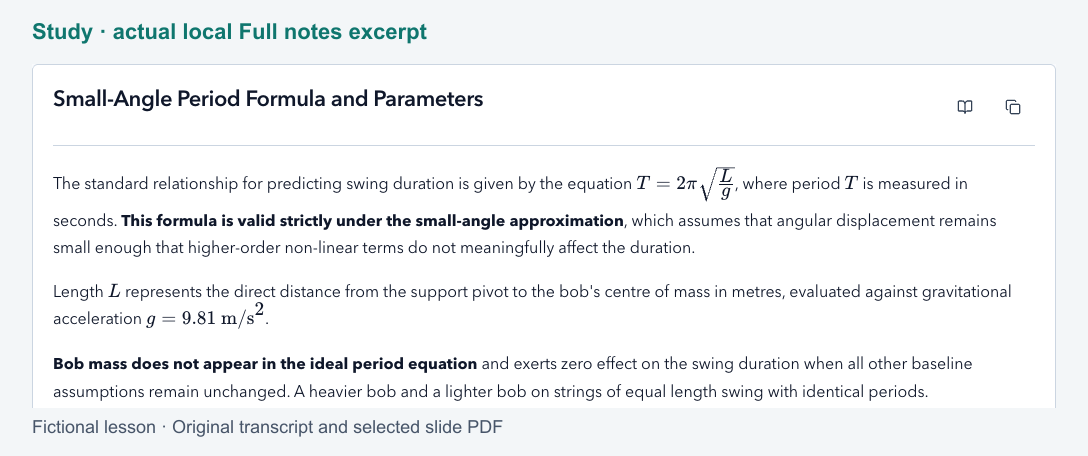
Generated explanations can contain mistakes or omit details. An attached source cannot recover information missing from its extracted text. Check the period's small-angle condition in the original passage, and do not assume that every reading will include the same practice activity or interaction.
Keep a copy and a short review list
Copy or download the guide when it is ready. Full notes Markdown exports include the reading, citations, and written versions of interactive material; live controls do not run in Markdown. Check the exported file before sharing source excerpts.
For this lesson, the useful next step is to answer the five questions with the guide covered. Revisit only the points you missed, and leave the large-angle calculation on the unresolved list until you have an appropriate source.
The original transcript, slides, and editorial study guide are licensed under CC BY 4.0. Attribute the resource title to Vyxora Editorial, link to this article and the license, and state whether you changed it. This license excludes the Vyxora mark, product UI, software, and third-party material.