
Research notes
How to Compare Customer Interviews and Write Findings
Compare interview evidence in a reusable matrix, write findings you can trace to participants, and keep conflicting feedback visible.
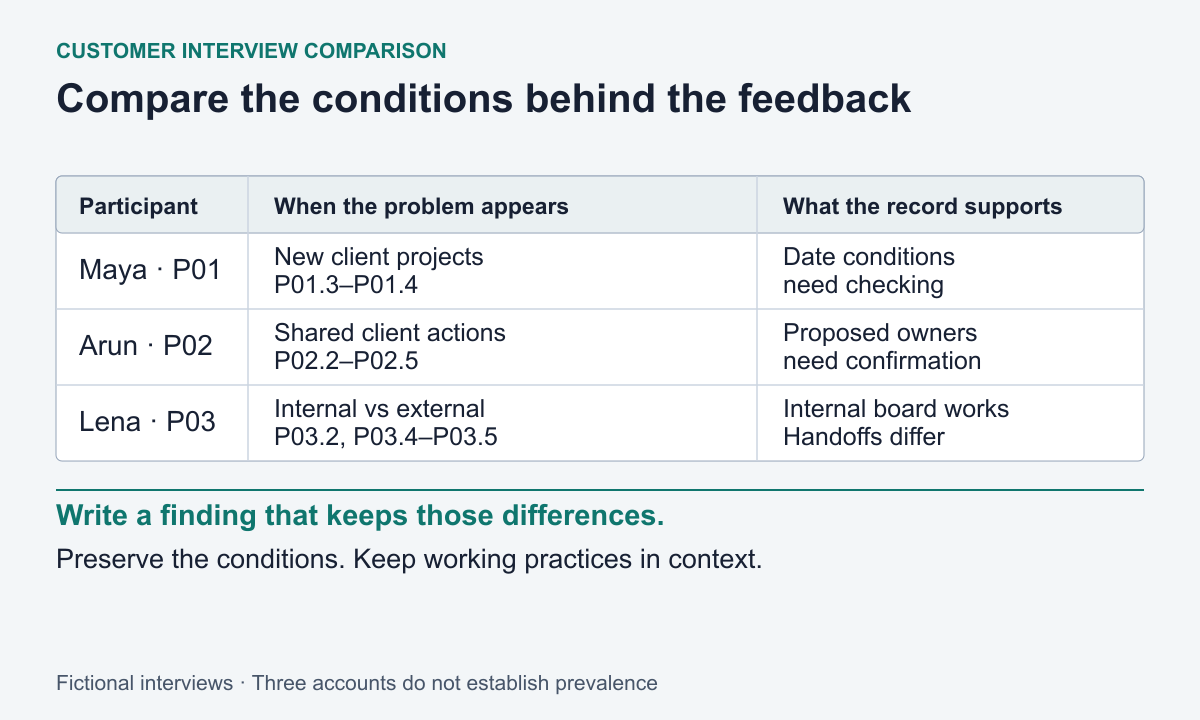
Compare interviews around one question, keep each observation attached to its participant and source, and write a finding that says when it holds. Use the matrix and memo below to separate what people described from your interpretation and proposed next steps.
Download the three transcripts, blank matrix, and filled matrix. The worksheet and completed memo are available without Vyxora.
Start with the finding you need to explain
All three interviews are fictional. Maya, Arun, and Lena were written for this exercise, not interviewed as customers. The records demonstrate a practical comparison method; they are not evidence of market demand or population prevalence.
The question is: What information do people need when returning to work discussed in a client call? Here is a finished memo you can trace through the records below.
Choose a question before building the matrix
A question gives you a reason to compare a passage. Without it, every vivid comment can become a separate theme, and unrelated workflows can be flattened into one supposed need.
For this exercise, P01 concerns one person's client follow-up. P02 concerns shared delivery. P03 distinguishes internal work from external handoffs. That context matters before you compare their tools or requests.
If you are still preparing a single interview, use the earlier transcript-analysis walkthrough. This article starts after you have records from several sessions and need to explain their similarities and differences.
Use only records you have permission to process. The UK government's guidance on recording user research advises keeping notes tied to observations, using participant and session labels, and protecting personal information. Your consent, access, and retention obligations still apply when software helps with analysis.
Put one observation on each row
Open the CSV in Excel, Google Sheets, or another spreadsheet app. Keep the source locator on the same row when sorting or filtering. Use the Markdown worksheet if you prefer a document. Add rows rather than compressing several different observations into one cell.
The full matrix includes separate fields for observation, analyst interpretation, qualification, and follow-up. This shorter view shows the comparison:
| Participant and context | Source | Observation | Qualification |
|---|---|---|---|
| Maya, familiar weekly check-in | P01.2–P01.3 | One follow-up took about ten minutes | Not a claim about all client follow-ups |
| Maya, new projects | P01.3 | Replays the conditions around a date | A different situation from the weekly check-in |
| Maya, personal task management | P01.4 | Keeps her own tasks in a short list | Does not describe problems confirming who accepted shared work |
| Arun, shared studio delivery | P02.2 | Recap did not confirm who had accepted an action | Does not establish that the action was missed |
| Arun, initial feature request | P02.3 | Suggests automatic assignment | Qualified by P02.4 |
| Arun, ownership confirmation | P02.4 | Rejects assignment based only on a mention | Wants the proposed owner to confirm |
| Arun, client approval | P02.5 | An omitted condition makes a date read as a promise | His account, not a measured failure rate |
| Lena, internal meetings | P03.2 | Existing task board works | Does not request another task list |
| Lena, decision history | P03.3 | Keeps a note explaining why a decision changed | Current task and decision rationale serve different needs |
| Lena, partner handoffs | P03.4 | Asks who accepted an external action | P03.5 separates this from the internal process |
A short quotation is useful when its wording matters, but read the surrounding passage before lifting it. P02.3 says the software should assign tasks automatically. P02.4 narrows that request: being mentioned should not create an assignment. A matrix containing only the earlier sentence would misrepresent this participant.
Compare the conditions, not just repeated words
Maya and Arun both discuss dates, but their circumstances differ. The supported comparison is about preserving a dependency when returning to a discussion. It is not “all customers struggle with follow-up.”
Arun and Lena both discuss accepted ownership, but Lena's example concerns an external partner. Her internal meetings already update a task board. Keep the internal row even if it weakens an attractive story about replacing task tools.
Do not treat an empty cell as “no problem.” Lena was not asked directly about date conditions. Write not asked. If a transcript is incomplete, write not recorded and identify the missing material. The absence of a statement is not a negative response.
Write the finding, support, and boundary together
Use this structure in a research memo or a section of your product-planning document. Replace every bracketed field with your own evidence, interpretation, and scope. Add another finding only when you can trace it just as clearly.
Trace each interpretation in the memo to the interviews you reviewed. Repeated mentions can help you notice a question worth investigating; three fictional accounts cannot tell you how common a need is or whether anyone would buy a solution. Formal qualitative research also requires a method appropriate to its question, ethics, and claims.
Use software to retrieve the passages you need
If you use Vyxora, keep the interviews as distinct Notes so each account remains identifiable. A Workstream can bring related Notes and files together for source-backed questions. Ask which passages support a proposed finding, then open them and check the conditions and differing accounts yourself.
Full notes on an individual interview Note can provide additional explanation, but generated prose is not a new participant statement or independent evidence. Preserve the original records and distinguish your analysis from their wording. Full notes source boundaries, checked November 17, 2026.
Reuse the comparison resources
The original fictional transcripts, comparison resources, and memo are licensed under CC BY 4.0. Attribute the relevant resource title to Vyxora Editorial, link to this article and the license, and state whether changes were made. The license excludes the Vyxora mark, product UI, software, and third-party material. Keep that attribution beside copied CSV data or in the document where you reuse it.
Before sharing real findings, check each source reference, review the accounts that differ, and remove identifying material the recipient should not receive. Finish by naming the next question the evidence leaves open.