
Research notes
How to Analyze Interview Transcripts and Turn Them Into Notes
Follow one fictional customer interview from raw transcript to codes, themes, evidence-linked findings, corrections, and useful follow-up questions.
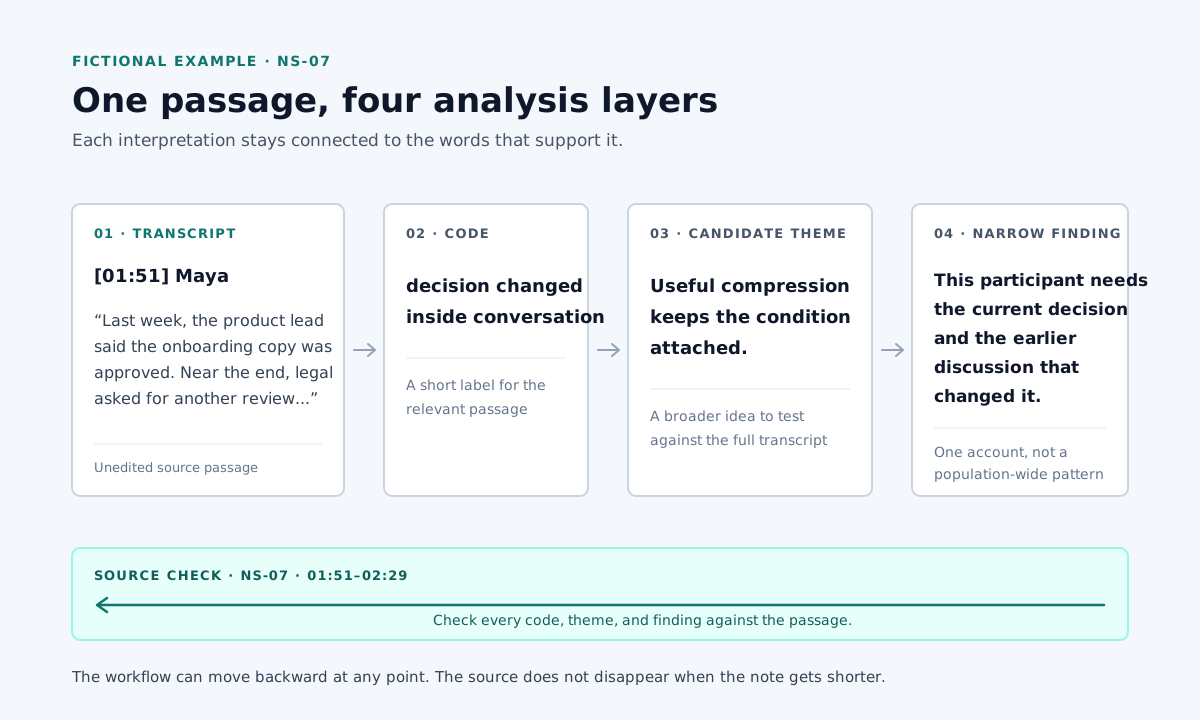
A useful interview note shows what the participant said, what you think it means, and where someone can check that interpretation.
This guide works through one fictional customer interview. The example includes an early answer that gets corrected, a decision that changes during the conversation, a feature request that points to a deeper need, and a claim that one interview cannot settle. You can download the source transcript and compare it with the finished analysis.
Practice with the same files
Know what you are making
Four layers often get blurred together:
- A transcript records the conversation. It may still contain transcription mistakes.
- A code is a short label attached to a relevant passage.
- A theme brings related codes together around a broader pattern or central idea.
- A finding is the claim you write after interpreting the evidence.
Codes are narrower than themes. Braun and Clarke describe codes as labels for features of the data that may matter to the research question, while themes are broader patterns built and refined through analysis. They also stress that qualitative analysis is situated and subjective, not the mechanical discovery of a single correct answer (Thematic Analysis: Doing Reflexive TA; code and theme FAQ).
The walkthrough below borrows that useful separation without claiming to conduct a complete reflexive thematic analysis. It analyzes one fictional interview for practical note-making. A formal research project needs a method suited to its question, ethics, sample, and claims.
Start with a question and an untouched source
Our fictional question is:
What makes meeting and customer-interview follow-up difficult, and what must useful notes preserve?
Keep an unedited master transcript. Add stable locators such as timestamps or line numbers so each note can point back to its context. A practical guide to interview-based qualitative research recommends formatting transcripts for coding and notes that line numbers can make passages easier to locate (Academic Emergency Medicine, 2015).
Before analyzing a real transcript, remove or protect identifying details according to the consent, access, and retention rules for your work. The UK Data Service warns that qualitative transcripts can remain identifiable through contextual details and speech patterns even after obvious names are removed (UK Data Service, 2025).
Read the whole interview before lifting quotes
Read the transcript from beginning to end and write a short memo. Do not begin by collecting the most quotable sentences. The participant may narrow, reverse, or correct an answer later.
The fictional participant, Maya, first says:
“I said in the survey that follow-up takes ten minutes.”
[01:23]
She immediately adds a condition:
“That's true when it is our weekly check-in and everyone knows the project. For customer calls or planning sessions, it can take forty-five minutes because I replay sections.”
[01:23–01:48]
At the end, she corrects the record again:
“The ten-minute follow-up answer. I do not want that quoted without the condition.”
[12:03–end]
“Follow-up takes ten minutes” would be a clean bullet and a bad note. The full interview supports a narrower statement: ten minutes described an easy weekly meeting, while more complicated calls took longer for this participant.
Code passages without rewriting them yet
Codes help you retrieve related passages. They are not polished findings.
Here are five passages from the fictional transcript:
| Source | What Maya says | Initial code |
|---|---|---|
01:51–02:29 | Product approved the copy, then legal reopened review | decision changed inside conversation |
02:52–03:20 | She checks wording and ownership; if unclear, she writes “owner to confirm” | verify sensitive details; preserve uncertainty |
03:23–04:31 | A dashboard request pointed to a need for cross-team status | requested feature differs from underlying need |
04:53–05:28 | Pull out useful material, keep its source nearby, and edit the first pass | evidence-linked editable draft |
07:24–08:28 | One interview is an observation; later interviews must test the condition | limit claim to available evidence |
A code can stay close to the participant's wording or express an analytic idea. Whichever style you use, define it clearly enough that you can apply it consistently. If a passage fits two codes, keep both rather than forcing it into one box.
Group codes into candidate themes
Several codes may point toward the same larger idea. In this example, three codes connect:
- decision changed inside conversation
- preserve conditions and exceptions
- participant corrected an earlier answer
Candidate theme: Useful compression keeps the condition attached.
That name makes a claim about the relationship between the codes. A heading such as “Meeting notes” would only name the topic. Braun and Clarke distinguish a theme with a central organizing idea from a topic summary that gathers everything said about a subject (Thematic Analysis FAQ).
Another group contains:
- verify sensitive details
- owner remains uncertain
- evidence-linked editable draft
Candidate theme: Trust comes from review and traceability.
Treat the theme as a candidate. Return to every supporting passage and then to the full transcript. Split, combine, rename, or drop themes that do not hold together. The six-phase reflexive thematic analysis guidance treats this as a recursive process rather than a checklist completed once (Doing Reflexive TA).
Write findings that the passages can support
A finding needs evidence and interpretation. Keep those parts visible:
Source passage
“The product lead said the onboarding copy was approved. Near the end, legal asked for another review, so it was not really approved anymore.”
[01:51–02:25]
Code
decision changed inside conversation
Candidate theme
Useful compression keeps the condition attached
Narrow finding
This participant needs meeting notes to show the current decision and the earlier discussion that changed it.
Interpretation
A current-state summary alone would hide why the task reopened. A chronological transcript alone would make the current state slow to find. This participant describes needing both.
The interpretation is the analyst's work. It should not be presented as the participant's exact statement. Interview-analysis guidance recommends keeping participant quotations available so readers can see the basis for an interpretation (Canadian Journal of Hospital Pharmacy, 2015).
Keep contradictions, corrections, and exceptions
Do not make the account look more consistent than it is. A contradiction may reveal a condition, a change over time, uncertainty in the question, or a real disagreement.
The fictional transcript has three useful tensions:
- Ten minutes versus forty-five minutes. Meeting type changes the answer.
- Approved versus reopened. The state changes during the conversation.
- Write almost everything versus pay attention. Detailed manual notes protect recall but cost the participant opportunities to ask follow-up questions.
Record both sides, return to the surrounding passages, and write what the evidence permits. Research on collaborative qualitative analysis describes looking deliberately for disagreements and contrasting experiences rather than collecting only confirming examples (Research Involvement and Engagement, 2016).
Turn gaps into follow-up questions
One interview can expose a useful question without answering it for everyone. The Northstar example produces several:
- When do other project leads treat a spoken proposal as a confirmed decision?
- Which meeting types require checking audio as well as the transcript?
- Do other researchers separate a requested feature from the problem beneath it?
- Who reviews generated notes before they become a team record?
- How should access differ between raw transcripts and shared findings?
These questions are more honest than promoting a vivid quote into a broad claim. They also improve the next interview guide.
Review the note against the source
Before sharing the analysis, check it in this order:
- Trace every finding. Can you open the exact source passages behind it?
- Separate voices. Can a reader tell participant words from analyst interpretation?
- Check the whole transcript. Did a later answer change an earlier one?
- Look for disconfirming material. What limits or contradicts the candidate theme?
- Narrow the claim. Does the wording match what one interview can support?
- Protect the participant. Are names, roles, events, and access handled according to consent and policy?
- Review high-stakes details. Check commitments, owners, dates, and sensitive wording against the original recording when available.
Generated transcripts and notes can contain mistakes, omit context, or assign words to the wrong speaker. Treat them as editable working material. For formal qualitative research, use a documented methodology and the ethics, reflexivity, review, and quality practices required by your field.
Sources and disclosure
Sources were checked on August 25, 2026:
- Virginia Braun and Victoria Clarke, Doing Reflexive Thematic Analysis and Thematic Analysis FAQs.
- DeJonckheere and Vaughn, Interview-Based Qualitative Research in Emergency Care Part II, Academic Emergency Medicine (2015).
- Sutton and Austin, Qualitative Research: Data Collection, Analysis, and Management, Canadian Journal of Hospital Pharmacy (2015).
- Sweeney and colleagues, The case for multiple coding, Research Involvement and Engagement (2016).
- UK Data Service, Introduction to anonymisation techniques for social sciences research data (2025).
The interview and company in this article are fictional. The example does not report a study or customer result.